Money for
Chapters
- Feeling behind vs being behind
- Sign 1: A surprise bill doesn't scare you
- Sign 2: You spend less than you earn
- Sign 3: No expensive debt
- Sign 4: You invest, even a little
- Sign 5: Your net worth is growing
- Sign 6: Your fixed costs leave room
- Sign 7: You know your numbers
- Why it doesn't feel like it
- Recap
Sources
Eurostat (2025): 29.2% of people in the EU can't face an unexpected financial expense from their own resources (Greece 50.5%, Latvia 43.7%, Romania 37.8%).
Eurostat: euro area household saving rate 14.4% in Q4 2025.
ECB Household Finance and Consumption Survey (2021): median net wealth of euro area households under 35 about €21,000.
€50 a month for 30 years at an example return of 7% a year: about €61,000 (not a forecast).
Watch next
How Rich Are You Compared to Other Europeans? (Official ECB Data)
7 Money Habits Keeping Young Europeans Poor
How to Start Investing in Europe with €100 (Step by Step)
Read the full transcript
You open Instagram, and everyone your age seems to own a house, travel every month, and have a perfect investment portfolio. And you feel behind. But feeling behind and actually being behind are two very different things. Today I'll show you seven signs that you're doing better with money than you think. Not measured against Instagram, but against real data from Eurostat and the European Central Bank.
If you can tick off even a few of these, you're probably doing better than you give yourself credit for. Here are the seven signs. Keep score as we go, and tell me your number at the end. Sign number one: a surprise bill doesn't scare you. A broken laptop, a car repair, a big dentist bill.
According to Eurostat, around twenty-nine percent of people in the EU couldn't pay an unexpected expense like that from their own resources. In some countries it's much higher. In Romania, almost four in ten. In Latvia, more than four in ten. And in Greece, about half the population.
So if you have even one month of expenses saved, you're on your way. Three to six months, and you're in a genuinely strong position. That buffer is what turns a crisis into an inconvenience. No buffer yet? Start here.
Open a separate savings account, and name it Emergency. Then set up an automatic transfer of even fifty euros, the day after payday. Keep it boring and keep it separate, so you don't spend it by accident. Sign number two: you spend less than you earn. Every month, without having to think too hard about it, there's money left over.
For a rough benchmark: Eurostat's household saving rate for the euro area was around fourteen percent at the end of 2025. It's measured differently from your personal savings, but it gives you an idea. If you consistently save ten to fifteen percent of your take-home pay, you're right on track. Twenty percent or more, and you're ahead of the game. And if it's just five percent right now, while rent is high and your salary is still growing, the habit matters more than the amount.
Here's a quick way to check. Look at your bank balance on the day before payday, for the last three months. Is it higher each time, or at least not lower? Then you're spending less than you earn, even if it never feels like it. Sign number three: you have no expensive debt.
A mortgage at a reasonable rate, or a low-interest student loan, isn't a red flag. Those are normal. But if you don't carry credit card balances, don't live in your overdraft, and don't pay for groceries in instalments, you're avoiding the trap that keeps millions of people stuck. Expensive debt grows against you, in the same way investments grow for you. Not having any is a quiet superpower.
Sign number four: you invest regularly, even if it's just a little. In most of Europe, a big part of household wealth sits in bank accounts and in the family home. Owning shares or investment funds is still far from normal in many countries. So if you have an automatic monthly plan into a broad index fund, you're already doing something many people never start. And small amounts count.
Fifty euros a month for thirty years, at an example return of seven percent a year, grows to around sixty-one thousand euros. Starting is the hard part. If you've started, you've done it. And don't worry about picking the perfect moment or the perfect fund. A broad, low-cost global index fund and time do most of the work.
The people who build real wealth in Europe usually aren't the ones with the best stock tips. They're the ones who kept going for twenty or thirty years. Sign number five: your net worth is going up. Net worth is simple: everything you own, minus everything you owe. Savings, investments, pension, and the part of your home you actually own, minus your loans.
It doesn't matter if the number is small, or even negative because of a student loan. What matters is the direction. For context: the European Central Bank's household survey found that the median household under thirty-five in the euro area had a net wealth of around twenty-one thousand euros. If you're under thirty-five and above that, you're above the middle. And if you're not there yet, but your number is higher than a year ago, you're moving in the right direction.
Tracking it is easy. Pick one date every year, for example your birthday. Write down everything you own and everything you owe, in a simple spreadsheet. Then compare with last year. That one number tells you more than any monthly budget.
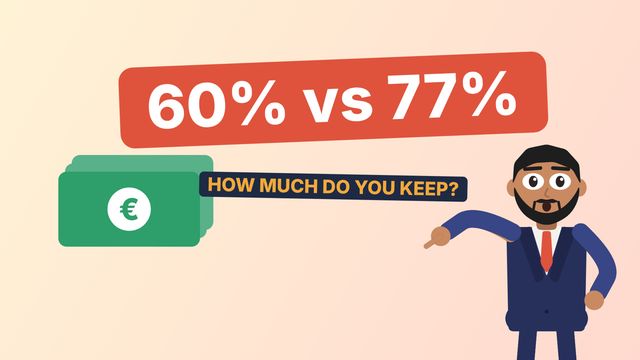
Sign number six: your fixed costs leave room to breathe. Rent or mortgage, utilities, insurance, transport and subscriptions. If all of that together takes less than about half to sixty percent of your take-home pay, you have flexibility. You can save, absorb a price increase, or change jobs without panic. In expensive European cities that's hard, which makes it even more of an achievement if you've managed it.
An example. Say you take home two thousand eight hundred euros a month, and your fixed costs are fifteen hundred. That's about fifty-four percent. It leaves thirteen hundred euros for food, fun, saving and investing. That's breathing room.
And sign number seven: you know your numbers, and you have a plan. You roughly know what comes in and goes out each month. You've at least looked at what your state and workplace pension will give you. And your money has a job: a buffer, a home, financial freedom one day. Most people never look.
Just by watching a video like this, you're already paying more attention than most. If you haven't checked your pension yet: most EU countries have an official website, or a yearly letter, that shows your expected state pension. Look it up for your country this week. It takes ten minutes, and it's one of the most useful things you can know. So why doesn't it feel like you're doing well?
Because you compare your everyday life with other people's highlights. Because rent and prices rose fast for years. And because you notice the people above you, never the many people behind you. Feeling behind is normal. It's just usually not true.
So: a buffer for surprises, spending less than you earn, no expensive debt, investing regularly, a growing net worth, fixed costs that leave room to breathe, and a plan. How many did you tick off? Scored three or lower? Don't worry, here's the order to work in. First, build a buffer of one month of expenses.
Second, pay off any expensive debt, highest interest first. Third, automate a small monthly investment, even fifty euros. Do those three, and next year you'll tick off a lot more. Tell me your score out of seven in the comments. No judgement, just honesty.
If this helped, subscribe for clear money videos made for Europeans. And if you want to see how your wealth compares with other Europeans, watch this one next.
One money move for Europeans, every Sunday
The week's videos, one practical tip and one tool worth knowing. Free, and you get the European ETF Starter Checklist straight away. Unsubscribe anytime.
Form not showing? Sign up here. No spam. Your email is handled by beehiiv; see our privacy policy.